



Prof. Dr. Mehmet Özger addressed the concept of aesthetics from a historical perspective in his seminar. In his presentation, he detailed the evolution of the understanding of aesthetics from Ancient Greece to the Middle Ages, highlighting the different viewpoints of the Western and Islamic worlds on this topic. Özger compared the architecture of mosques and churches, illustrating how both structures reflect societal and religious values. He emphasized that the spaces in mosques evoke a feeling of drawing people closer to Allah, while in churches, figurative representations are more prominent.
A significant portion of the seminar focused on the importance of geometry in Islamic art. Prof. Dr. Özger highlighted through Fuzuli's geometric studies that geometry is a fundamental element of the order in the universe and the aesthetic understanding. Özger explained that “Geometry takes an X-ray of the beings in the universe,” using examples to clarify the role of this discipline in art and aesthetics. He discussed the place of the circle in Islamic aesthetics and explained the concepts of descent and ascent as metaphors for the journey between the world and the afterlife. He noted that this approach is based on harmony between the part and the whole in Islamic aesthetics.
The seminar also extensively discussed the fundamental differences between Islamic and Western aesthetics. Prof. Dr. Özger pointed out that Western art places emphasis on figurative representations (such as painting and sculpture), while Islamic art prefers abstract elements. He explained the lack of perspective in miniature art as an approach based not on a human but a divine perspective, stating that this difference forms the basis of aesthetic perception.
Özger emphasized that the principle of tawhid (unity) lies at the core of Islamic aesthetics, noting that mosques are often built in the center of cities with durable stone materials, symbolizing the majesty of Allah. In contrast, homes are constructed with more fragile materials, symbolizing the brevity of human life.
One of the key parts of the seminar was the reflection of Islamic aesthetics in literature. Özger analyzed the poems “Takvimdeki Deniz” by Necip Fazıl and “Balkon” by Sezai Karakoç, using these works to explain the abstract nature of Islamic aesthetics. He also provided examples from poems written under the influence of Western aesthetics, showing how these works, with their individual-centered approaches, differ from Islamic aesthetics. Özger drew attention to the sensory and metaphysical dimensions of Islamic aesthetics through the expression "Bişnev!" (Listen!) in the Masnavi.
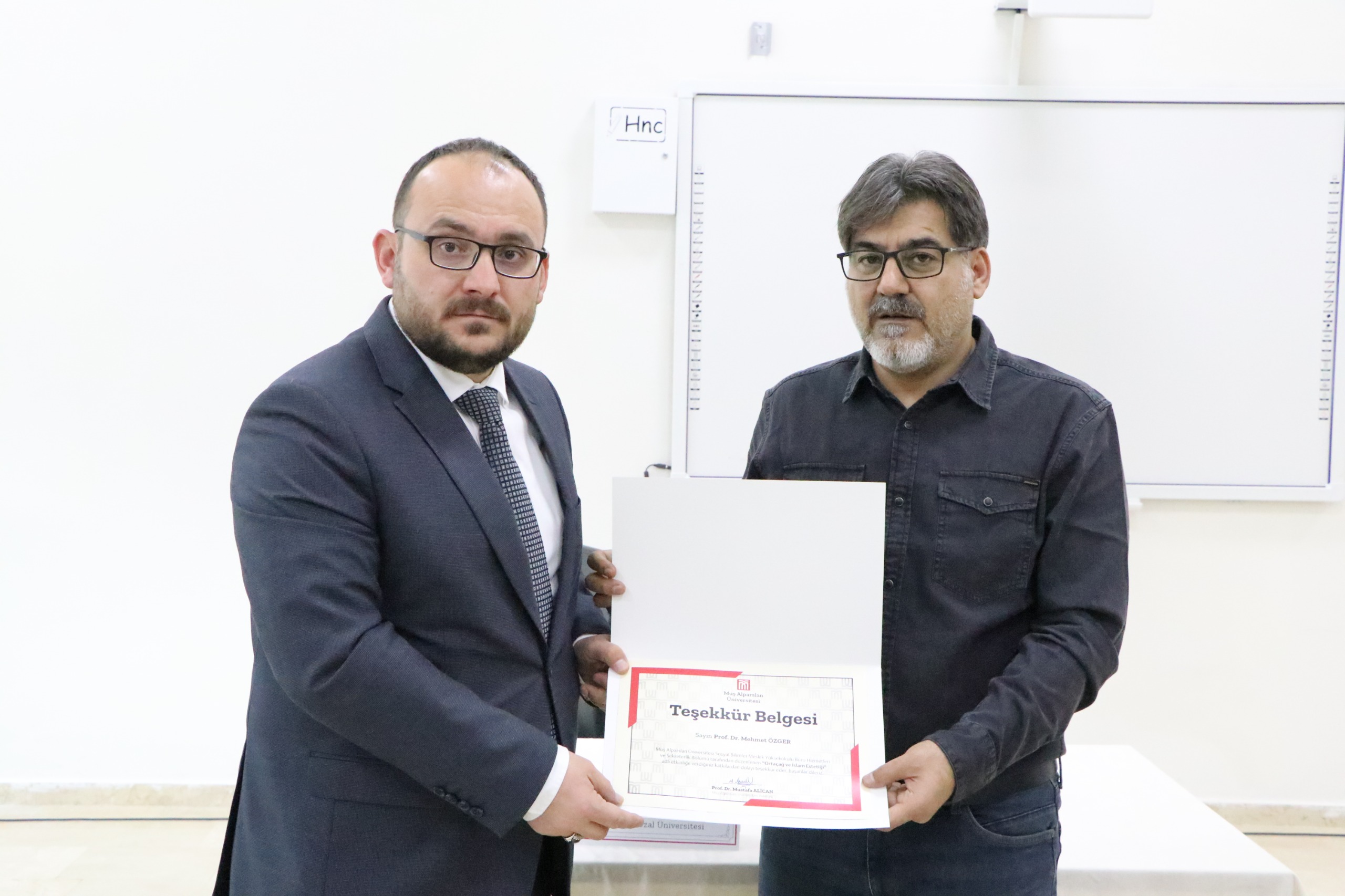
The seminar concluded with a question-and-answer session with the participants. The program ended with a certificate of appreciation presented to Prof. Dr. Mehmet Özger by our Rector, Prof. Dr. Mustafa Alican, for his contributions.
 Muş Alparslan University